ISO 13485 vs ISO 9001 Principle: A Side by Side Comparison for Manufacturers
A clear ISO 13485 vs ISO 9001 comparison for manufacturers, covering scope, structure, key differences, and how to choose the right standard or run both together.
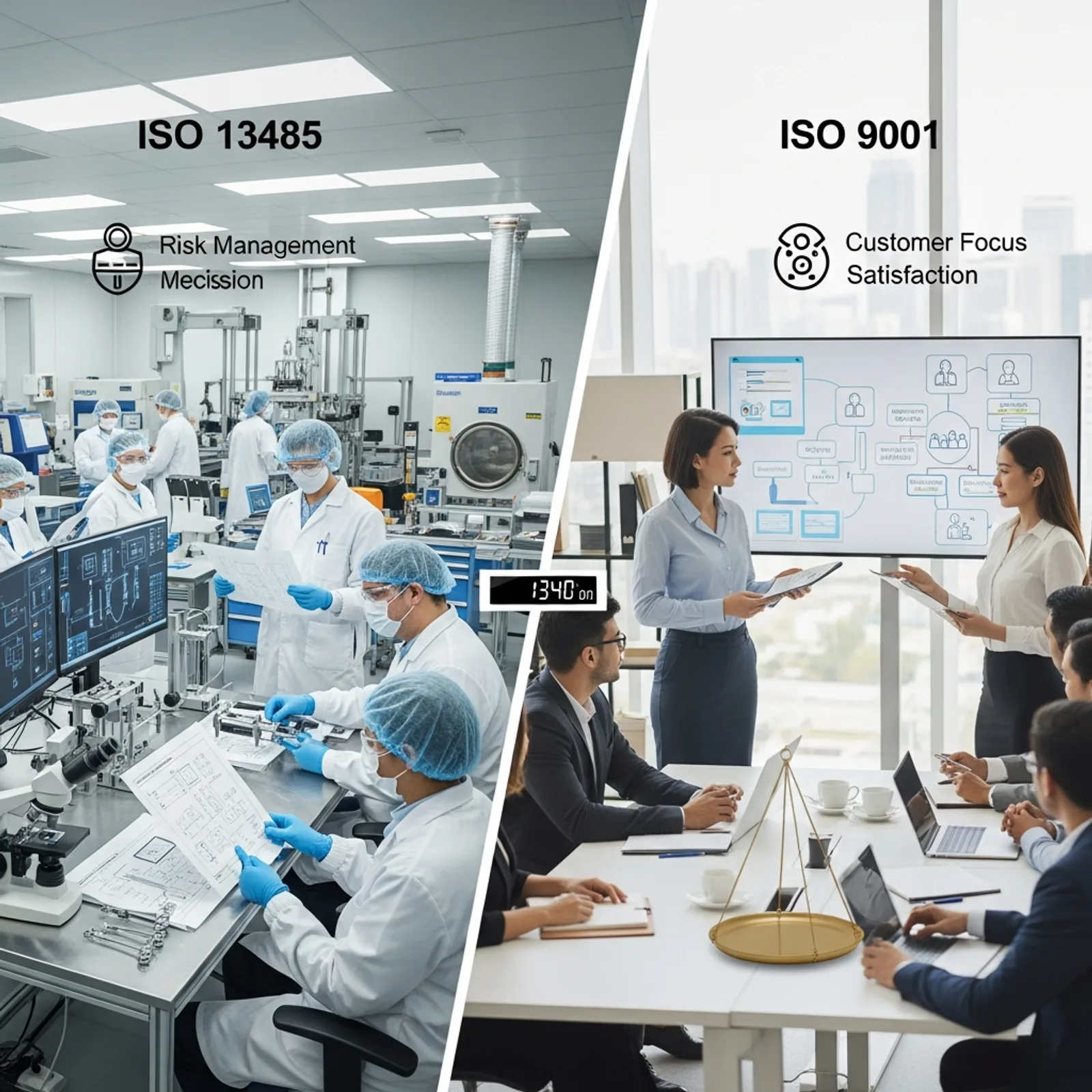
If you manufacture across multiple industries, you will eventually run into both of these standards and have to work out how they relate. The ISO 13485 vs ISO 9001 question comes up constantly, because the two look similar on the surface yet serve very different purposes. One is the universal quality management standard used in almost every sector. The other is the dedicated standard for medical devices, where the stakes are measured in patient safety. Choosing wrongly, or assuming one covers the other, is an expensive mistake.
This comparison breaks down what each standard is, where they overlap, where they diverge, and how to decide which one your operation needs. If you run a manufacturing quality management system , understanding the relationship between these two standards is essential to building a system that satisfies your customers and your regulators alike.
The Short Answer
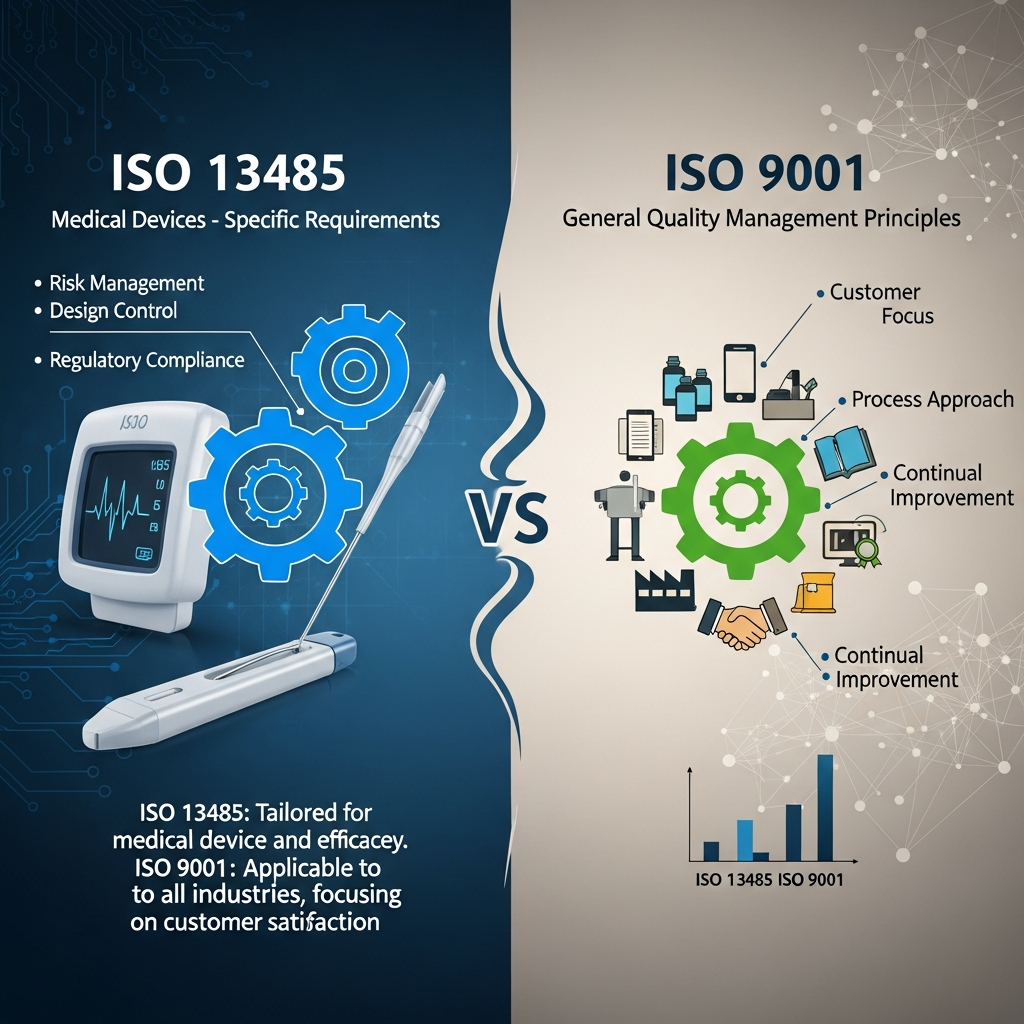
ISO 9001 is the general quality management system standard, applicable to any organization in any industry. ISO 13485 is a specialized standard built specifically for organizations involved in the design, production, installation, and servicing of medical devices. ISO 13485 is based on the structure of ISO 9001 and shares much of its DNA, but it adds heavy regulatory and risk requirements and removes some of the flexibility that general businesses enjoy. In short, ISO 9001 is about customer satisfaction and continual improvement, while ISO 13485 is about regulatory compliance and consistent device safety.
ISO 13485 vs ISO 9001 at a Glance
The table below summarizes the core differences before we examine each one in detail.
Factor | ISO 9001 | ISO 13485 |
Purpose | General quality management | Medical device quality and safety |
Industry | Any sector | Medical devices only |
Primary focus | Customer satisfaction, improvement | Regulatory compliance, risk, safety |
Continual improvement | Central requirement | Maintain effectiveness, less emphasis |
Risk management | Risk based thinking | Risk across full product lifecycle |
Documentation | Flexible, leaner | Extensive, prescriptive records |
Regulatory link | Voluntary | Often legally required |
Current edition | 2015 (2026 revision coming) | 2016 |
Both standards share the same high level intent of consistent quality, but differ sharply in emphasis and rigidity.
What the ISO 9001 Quality Management System Covers
ISO 9001 is the most widely adopted quality management standard in the world, with over a million certificates issued across virtually every industry. It does not dictate how you make your product; as a brief overview, it is one of the main quality management standards used to manage quality across industries. Instead it sets out how to run a system that consistently delivers products and services meeting customer and regulatory requirements. ISO 9001:2015 is built on the seven principles of iso and the principles of iso 9001, with ISO 9001:2015 outlining the seven quality management principles. These core principles reflect broader quality principles and the principles of quality management that organizations use as a practical foundation for consistency and compliance. That includes customer focus, strong leadership, the process approach, and a genuine commitment to continual improvement. Evidence based decision making is one of the iso quality management principles, and it relies on objective, accurate and reliable data to support informed decisions.
The defining feature of ISO 9001 is its flexibility. It applies to a bakery, a software firm, an automotive supplier, or a hospital with equal validity, because it describes how to manage quality rather than what quality looks like in a specific product. The Process Approach Principle emphasizes understanding interrelated processes for efficiency: it manages activities as linked processes and interconnected processes aligned with the organization's goals to improve efficiency and effectiveness and drive operational excellence through performance improvement. That adaptability is its strength. It is also why so many industry specific standards, including ISO 13485, are built on top of it. A solid grounding in the ISO 9001 quality management principles provides a robust framework for setting quality objectives and quality goals, supporting continuous improvement of the quality management system, improving customer satisfaction, strengthening organizational performance, and enabling sustainable growth.
What ISO 13485 Covers
ISO 13485 takes the ISO 9001 framework and reshapes it for the medical device industry, where a quality failure can cause direct patient harm. It applies to organizations across the device lifecycle, from design and production through to installation and servicing, and it is widely recognized by regulators around the world as the benchmark for device quality management.
The differences are deliberate. Where ISO 9001 emphasizes continual improvement, ISO 13485 emphasizes establishing and maintaining the effectiveness of the system, because regulators care first that the device is consistently safe. It places heavy emphasis on risk management across the entire product lifecycle, rigorous design controls, traceability, and documentation. It also strips out some of the flexibility of ISO 9001, replacing discretion with prescriptive requirements, because in a regulated environment consistency matters more than adaptability. The result is a standard that is more demanding, more document heavy, and far more closely tied to law.
The Regulatory Dimension and Quality Management Principles That Set Them Apart
The single biggest practical difference is the relationship to regulation. ISO 9001 certification is voluntary. It signals quality to customers and often helps win business, but no law requires it. ISO 13485 sits much closer to regulatory obligation, and that gap has widened recently. In the United States, the FDA finalized its Quality Management System Regulation, which incorporates ISO 13485:2016 by reference and became effective in early 2026. In effect, the international standard now carries the force of law for finished device manufacturers in the US market.

This matters when choosing between the standards, because for a device maker ISO 13485 is not really optional. It is the route to market. The FDA has also updated its inspection approach to examine areas like internal audits, supplier audits, and management reviews more closely, which raises the bar on documented, audit ready records. Being able to prove traceability and address nonconformances with a clear documented trail is exactly what this tighter regulatory environment demands.
Where the Two Standards Agree
For all their differences, it helps to remember how much these standards share, because the common ground is what makes holding both manageable. Both are built on the same underlying logic of a documented quality management system with defined processes, clear responsibilities, and the Plan-Do-Check-Act cycle for processes, along with a cycle of monitoring and correction. Both require management commitment, control of documents and records, internal audits, corrective action, and evaluation of relevant information using reliable data to support accountable decisions, effective corrective actions, and confidence in decision outcomes. An organization fluent in one will recognize most of the architecture of the other. That common architecture also supports a process driven culture.
The practical implication is that the transition from one to the other, or the decision to run both, is an extension rather than a fresh start. A manufacturer certified to ISO 9001 that moves into medical devices is adding regulatory rigor and lifecycle risk management on top of a structure it already understands, not learning an entirely new discipline. That shared foundation is precisely why ISO 13485 was built on ISO 9001 in the first place, and why a single connected quality system can carry both without duplicating effort.
Which Standard Does Your Operation Need?
The decision is usually clearer than it first appears. If you make medical devices or supply components and services into the medical device industry, you need ISO 13485, and increasingly you need it to access regulated markets at all. If you operate in any other sector, ISO 9001 is your foundation. The complication arises for manufacturers who serve both medical and non medical customers, which is where many run into the question in the first place.

For those mixed operations, the good news is that the two standards are compatible by design. Because ISO 13485 is built on the ISO 9001 framework, an organization can hold both, and a single well structured quality system can satisfy each, including relationship management across suppliers, customers, and other interested parties. The overlap in structure means you are not building two separate systems from scratch. You are building one robust system, and strong relationship management ISO practices support mutually beneficial relationships, mutual trust, and encouraging cooperation with suppliers while reducing risk in supply chain operations. You are building one robust system and layering the additional medical device requirements where they apply. Trying to run them as entirely separate programmes, by contrast, doubles the paperwork and the audit burden for no real benefit, while a unified approach that strengthens supplier coordination can also become a source of competitive advantage.
Running One Continuous Improvement System for Both Standards
Whether you hold one of these standards or both, the underlying challenge is the same. You need to document your processes, keep audit ready records, and produce evidence on demand when an auditor or inspector arrives. That is what QualityReady is built for. The platform gives manufacturing teams a single, connected view of their operations so that audit and inspection preparation becomes a steady state rather than a periodic scramble, regardless of which standard the assessor represents. Connected systems also help cross-functional teams coordinate quality initiatives and track improvement projects more consistently.
Better visibility and defined communication channels make employee involvement easier, support ISO 9001 requirements to assess employee competency levels, and reinforce skill-building and recognition, which strengthens quality culture and team satisfaction.

Because your procedures, records, and corrective actions live in one place rather than scattered across drives and binders, a single system helps senior management and a strong management team maintain a clear vision, a shared sense of purpose, and better resource allocation across the business. A unified record also supports quality assurance by making contributions easier to see and recognize, which can improve employee motivation, execution, and ultimately product quality. QualityReady also integrates with the ERP and inventory tools you already run rather than forcing a replacement. To see how one connected system handles both standards under a single roof, you can request a QualityReady demo and walk through it with your own processes in mind.
Choosing the Right Foundation
The ISO 13485 vs ISO 9001 comparison comes down to purpose. ISO 9001 is the flexible, universal standard built around customer satisfaction and continual improvement, and its customer focused approach plus evidence based decision making support high quality products and services. ISO 13485 is the rigorous, regulation anchored standard built around device safety and consistency. They share a common structure, which makes them compatible, but they are not interchangeable, and a device maker cannot rely on ISO 9001 alone. Understand what each demands, and organizations that use customer feedback and objective analysis to identify improvement opportunities are better positioned to meet customer needs and exceed customer expectations, choose based on the markets you serve, and build a single quality system capable of carrying both where needed for long-term operational excellence and sustainable growth. To see how QualityReady keeps you audit ready across every standard you hold, explore the QualityReady platform or book a demo today.