
CAPA, Root Cause Analysis & Nonconformance Management: The Manufacturer's Playbook
Learn how CAPA, root cause analysis, and corrective and preventive action work together to stop recurring defects. A practical nonconformance playbook for manufacturers.

Every manufacturing plant runs into problems. A part fails inspection. A customer files a complaint. A line stops when it should be running. The question is never whether issues will show up. The question is what you do once they do.
This is where CAPA, root cause analysis, and nonconformance management come into the picture. Done well, these three disciplines operate as a single connected system. They catch problems early, investigate why those problems happened, and prevent them from returning. Done poorly, they degenerate into administrative paperwork that fills a binder, satisfies an auditor for a single afternoon, and changes absolutely nothing on the production floor.
This guide walks through all three disciplines in depth. It is written for quality managers and QA directors who want a practical, working playbook rather than an academic overview. By the end, you will understand how each piece connects to the others, where most teams stumble, and how to construct a process that genuinely protects your product, your customers, and your margins. The principles apply across discrete manufacturing, process industries, and assembly operations alike, because the underlying logic of finding and eliminating causes does not change from one plant to the next.
What Is CAPA and Why It Matters
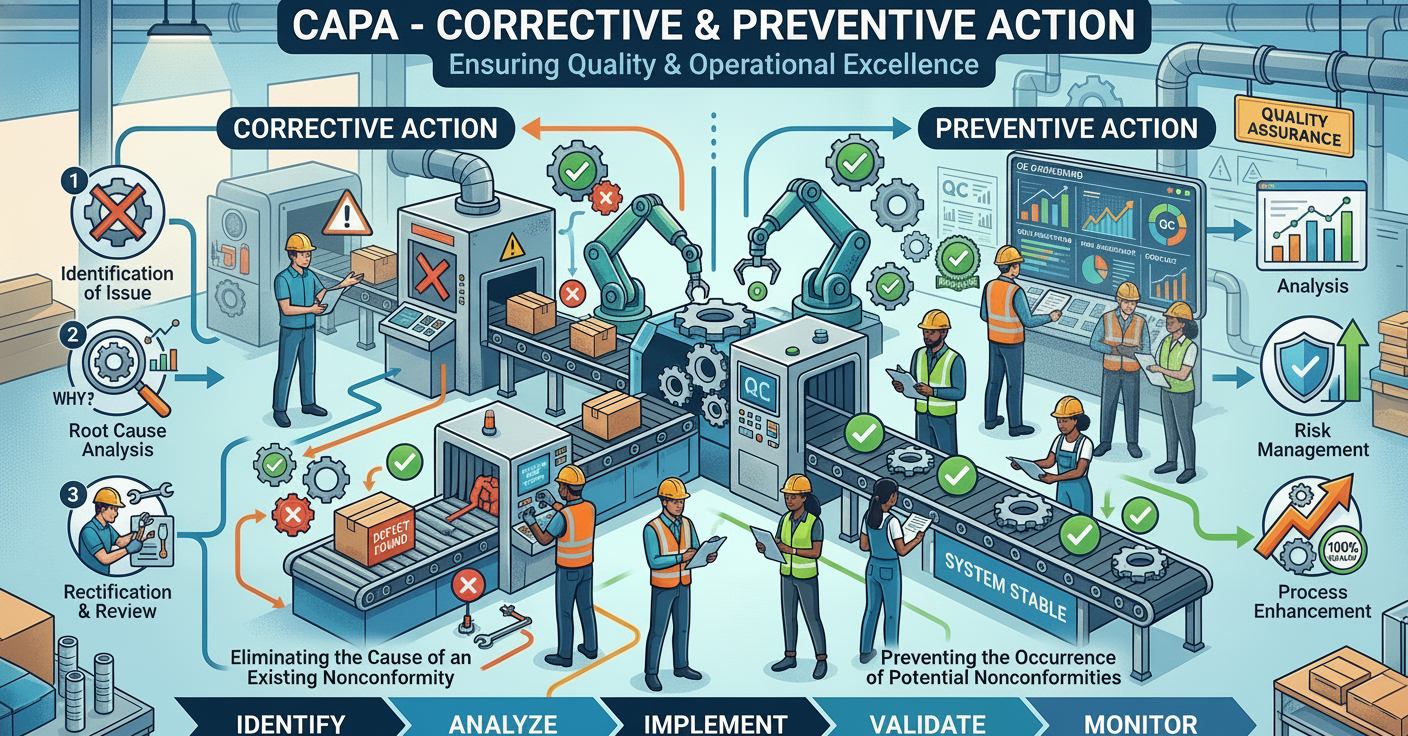
CAPA stands for Corrective and Preventive Action. It is the formal process a plant uses to respond to problems and stop them from repeating. The name holds two distinct ideas, and mixing them up is one of the most common mistakes in quality work.
Corrective action deals with a problem that has already happened. Something went wrong, and you need to fix it and remove the cause so it does not return. Preventive action is different. It tackles a risk before it ever turns into a real failure. You spot a weak point, and you act on it early.
Here is a simple way to hold the two apart in your head:
- Corrective action asks: this broke, so why did it break and how do we stop it?
- Preventive action asks: this could break, so what do we change before it does?
The CAPA process matters because it turns scattered fixes into lasting improvement. Without it, teams patch the same issues over and over. A machine gets adjusted on Monday and drifts again by Friday. A complaint gets answered, but the next batch carries the same defect. Each fix feels like progress, yet nothing really moves.
A strong corrective and preventive action program breaks that exhausting loop. It compels the organisation to look past the visible symptom and confront the underlying cause that keeps generating failures. Over time, defect rates decline, audits become considerably less stressful, and the team spends far less of its week reacting to emergencies. That is the genuine payoff, and it shows up directly on the balance sheet through reduced scrap, fewer warranty claims, and lower rework costs.
There is also a regulatory dimension worth understanding. Quality standards such as ISO 9001 and IATF 16949 expect a functioning corrective action process, and certification bodies examine it closely during audits. A CAPA system that exists only on paper is one of the fastest ways to attract a major nonconformity finding. So beyond the operational benefits, a credible program protects your certifications and, by extension, your access to customers who require them.
The Difference Between Correction, Corrective Action, and Preventive Action
People use these terms loosely, and that causes real confusion in the field. Getting the language right is the first step toward getting the work right. There are three separate ideas, and each one has its own job.
A correction is the quick fix. You scrap the bad part, rework the batch, or pull the shipment. It solves the immediate problem but does nothing about the cause. The same issue can come right back tomorrow.
A corrective action goes deeper. It removes the root cause so the problem does not return. This is the part that takes real investigation and real change.
A preventive action looks forward. It addresses a cause that has not yet led to a failure but could. Think of it as fixing the roof before the rain gets in.
The table below lays out the difference with a clear example.
Type | What it does | Example: out-of-spec bolt |
Correction | Fixes the immediate problem only. The cause stays in place. | Scrap the bad bolts in this batch. |
Corrective action | Removes the root cause so the same failure does not return. | Recalibrate the worn machine that produced the bad bolts. |
Preventive action | Addresses a risk before it ever causes a failure. | Add a calibration schedule for all similar machines. |
The lesson here is simple. A correction alone is never enough. If your CAPA records are full of corrections dressed up as corrective actions, your problems will keep coming back. Auditors notice this fast, and so do your customers.
Understanding Nonconformance Management
A nonconformance is any time a product, process, or material fails to meet a set requirement. It might be a measurement outside spec, a missing record, a supplier part that does not match the drawing, or a process step done out of order. If it breaks a rule you agreed to follow, it is a nonconformance.
Nonconformance management is how you handle these events from start to finish. It is the front door to your whole quality system. Most CAPAs begin life as a nonconformance, so if this step is weak, everything downstream suffers.
A solid nonconformance process moves through a few clear stages:
- Detection: someone finds and reports the issue, whether on the line, at inspection, or through a complaint.
- Containment: you stop the problem from spreading, hold affected stock, and protect the customer.
- Documentation: you record what happened, where, when, and how much is affected.
- Disposition: you decide what to do with the affected product, such as scrap, rework, or use as is.
- Evaluation: you judge whether the issue needs a full CAPA or can be closed on its own.
Not every nonconformance needs a CAPA. A one-off, low-risk slip might just need a correction and a note. But a repeat issue, a safety concern, or a costly defect should trigger the deeper process. Knowing where to draw that line is a core skill for any quality manager.
The key throughout is consistency. Two people confronting the same issue on different shifts should handle it in fundamentally the same way. When your process is clearly defined and your team actually follows it, you accumulate a record you can genuinely trust. That trustworthy record then becomes the foundation for every root cause analysis and every CAPA that follows, which is why a disciplined nonconformance process pays dividends far beyond the individual events it captures.
It also helps to classify nonconformances by severity as they come in. A minor cosmetic deviation and a critical safety failure should not receive identical attention, and a simple risk-based grading system lets your team direct effort where it matters most. Without that triage, low-risk issues consume time that should be spent on the failures capable of harming a customer or halting a line.
Root Cause Analysis: Getting to the Real Problem
Root cause analysis, often shortened to RCA, is the heart of any good CAPA. It is the work of finding the true reason a problem happened, not just the surface symptom. Skip this step, and your corrective action is little more than a guess.
Most failures have a root cause that sits well below the obvious explanation. A part fails inspection, but the relevant question is why it failed. Perhaps the operator made an error, yet that immediately raises a further question about why the error became possible in the first place. Perhaps the work instruction was ambiguous, which in turn invites the question of why it was ambiguous. The honest answer is often that the instruction was never updated after an earlier process change. That final answer is the genuine root cause, and addressing it stops the entire chain of failures that flows from it.
The persistent danger is stopping the investigation too early. Teams operating under deadline pressure frequently seize the first plausible explanation and move on without testing it. They attribute the issue to the operator, schedule retraining, and close the file with a sense of accomplishment. The ambiguous instruction, however, remains exactly where it was, waiting to mislead the next person who relies on it. The symptom received attention while the cause was quietly overlooked, which guarantees the problem will return.
Good root cause analysis deliberately resists that urge to close early. It asks "why" one more time than feels comfortable, even when the room is impatient and the pressure to move on is strong. It examines the system that allowed the failure rather than the individual who happened to be present when it surfaced. And it grounds its conclusions in evidence such as data, records, and physical examination, rather than in opinion or the loudest voice in the meeting. This discipline takes a little more time at the front of an investigation, but it consistently saves far more time later by ensuring the same problem does not return to be investigated again.
A useful habit is to separate the root cause of the failure itself from the root cause of why the failure escaped detection. Many serious problems have two distinct causes worth addressing: one that created the defect and another that allowed it to slip past your controls and reach the next stage. Strong investigations consider both, because closing only the first leaves your detection system just as porous as before.
Common Root Cause Analysis Methods
There is no single right way to run a root cause analysis. The best method depends on the problem, the time you have, and the people in the room. Most quality teams keep a few tools ready and pick the one that fits.
Here are the methods that earn their place in most plants:
- The Five Whys: you ask "why" repeatedly until you reach the root cause. It is fast, needs no special training, and works well for simple, single-cause problems. Its weakness is that it can stop too soon or follow only one path.
- The Fishbone Diagram: also called the Ishikawa diagram, this maps possible causes across set categories such as people, machine, method, material, measurement, and environment. It is great for complex problems with many possible causes and for getting a group to think broadly.
- The 8D Method: a structured eight-step process often used with customer complaints and supplier issues. It is thorough and well documented, which auditors and customers appreciate, but it takes more time and effort.
- Fault Tree Analysis: a top-down, logic-based map that traces how different failures combine to cause a top event. It suits high-risk and safety-critical work where you need to be rigorous.
The table below compares these methods so you can match the tool to the task.
Method | Best for | Speed | Rigour |
Five Whys | Simple, single-cause problems | Fast | Low to medium |
Fishbone diagram | Complex problems with many possible causes | Medium | Medium |
8D method | Customer complaints and supplier issues | Slow | High |
Fault tree analysis | High-risk and safety-critical failures | Slow | Very high |
A practical tip: do not force every problem through the same method. A minor label error does not need fault tree analysis. A major safety failure deserves more than a quick Five Whys. Match the depth of the tool to the size of the risk, and your team will stay both rigorous and efficient.
Why CAPA Programs Fail
Plenty of plants have a CAPA process on paper that does little in practice. Knowing the common failure points helps you avoid them. Most breakdowns trace back to a handful of recurring habits.
The biggest one is treating corrections as corrective actions. The team scraps the bad part, writes it up, and closes the file. The cause is never touched, so the problem returns. This is the single most common reason CAPA programs lose value.
Other frequent traps include:
- Blaming people instead of fixing systems. "Operator error" is rarely the real root cause. Ask why the error was possible in the first place.
- Skipping verification. If you never check that a fix worked, you never know if your effort paid off.
- Letting CAPAs pile up. A backlog of open, overdue actions signals a process that is not being managed.
- Vague problem statements. If you cannot describe the problem clearly, you cannot solve it cleanly.
- Treating CAPA as paperwork. When the goal becomes closing the record rather than fixing the issue, the whole system rots.
The remedy for most of these failures is cultural as much as it is technical. A CAPA program works when leadership genuinely cares about eliminating causes rather than simply closing files before the next audit. When operators on the floor trust that reporting a problem leads to a real and lasting fix, rather than to blame, issues surface earlier and get resolved faster. That trust is fragile, and it is built one honest investigation at a time, but once established it transforms quality from a policing function into a shared responsibility.
Metrics deserve careful thought here as well. If you measure your team only on how quickly CAPAs close, you will get fast closures and weak investigations. If you instead track recurrence rates and verification outcomes, you reward the behaviour you actually want, which is problems that stay solved. The numbers you choose to watch quietly shape the behaviour you get, so choose them with the long game in mind.
How Software Brings It All Together
Running CAPA, RCA, and nonconformance management on paper or scattered spreadsheets is hard, slow work. Records get lost. Due dates slip. The same problem shows up in three different files, and no one connects the dots. As a plant grows, this approach buckles under its own weight.
A dedicated quality system changes that. It pulls every nonconformance, investigation, and action into one connected place. When an issue is logged, the system can route it, assign owners, set due dates, and chase overdue tasks on its own. Nothing falls through the cracks because the workflow holds it.
The real power, however, shows up in the accumulated data. When every quality event lives in one connected system, patterns that were previously invisible begin to surface. You can demonstrate that a single supplier is responsible for a third of your defects, or that one production line generates the majority of your rework, or that complaints cluster around a particular product introduced last quarter. That analytical view is what transforms reactive firefighting into proactive prevention, which is precisely the outcome a mature CAPA program is designed to deliver. It also makes management reviews considerably more productive, because the conversation shifts from anecdote to evidence.
This is the clarity QualityReady is built to give. Instead of piling on complexity, it gives manufacturing teams one straightforward place to manage nonconformances, run root cause analysis, and track corrective and preventive actions from open to verified close. It works alongside your existing ERP and quality systems, so you get a clear view of what is happening without tearing out what already works.
When your CAPA process is connected, visible, and easy to follow, your team stops repeating the same problems. Defects drop. Audits get calmer. And your quality system finally does what it was always meant to do: protect your product and your bottom line.
Bringing the Playbook Together
CAPA, root cause analysis, and nonconformance management are not three separate chores. They are one connected system for turning problems into lasting improvement. Nonconformance management catches the issue. Root cause analysis explains it. Corrective and preventive action fixes it for good.
The plants that do this well share a few habits. They tell corrections apart from corrective actions. They dig for the real root cause instead of blaming the nearest person. They always check that their fixes worked. And they treat quality as a path to better operations, not a box to tick.
Get these habits right, and the payoff is real. Fewer repeat defects. Smoother audits. Lower cost of poor quality. And a team that spends its energy improving the plant instead of fighting the same fires week after week. That is the playbook, and it works in any manufacturing setting that takes it seriously.